Sunday, October 24, 2021

Conrad electric baritone guitar model 1247/Conrad electric guitar


Shouldn't be hard to look at this photo and tell which is the baritone.  Scale length differential is very apparent.  Its like a sibling photo where the big brother towers over the little.  As with many of these Japanese guitars it is difficult to nail down their birthplace and birthdate.  It is believed that these two guitars were Matsumoku products and wholesaled by a distributer out of Chicago.  Depending on the wholesaler as well as the company that was doing the retail these guitars came under a variety of names including Aria, Domino, Electra, Lyle, etc.  These Conrad guitars were distributed between the mid 60's to the late 70's.

On the left you have a baritone that I had fixed up by James Ralston.  This thing sounds crazy now, like you are plucking on piano strings!  It is tuned b to b and aside from giving you some incredible ethereal sounds it also gives you that great tic tac bass sound that Nashville was employing in the 50's.  James had to get the neck straightened out(which is a requisite repair on just about all of these Japanese wonders) and added a compensated saddle to help out with intonation.  It plays great now and is already providing inspiration in the studio.


These rocker switches were the low point of engineering on these guitars.  They have almost always been problematic and while James got these cleaned up and working pretty good, I am still searching for a better switching system that will fit the bill.  


It is tough to see, but there is a little treble boost switch east of the neck pickup - fender jaguar style.  These types of switches might be the answer to replacing the rocker switches.  


A little closer look at the pickups.  These pickups were seen on these offset models.  I have seen these Conrad guitars have anywhere from a one to four pickup configuration.


Many of these came with a straight metal bar saddle.  It was hell on the intonation, especially when you put a whammy bar into play.

Big, honking headstock!


The baritones little brother on the right came with an intonatable bridge and is all original.  Again, the rocker switches are less than desirable, but this guitar has some spunk and a chunky neck that I always personally desire.  Still in the process of dialing this one in and hoping to use it more once I do as it is a fun instrument to mess around with.


Sunday, October 3, 2021

Harmony H72V Electric Guitar


Some might say..."Why didn't you just go for a Gibson ES-335."  I would bet that the 335 feels a little more hefty in your hands and is the right choice for Larry Carlton, but as with all these Harmony and Kay guitars, so much of it comes down to vibe.  I am not a road guy so I don't need the reliability and something as easily replaceable as a 335.  Vibe counts, and this guitar has tons of it.

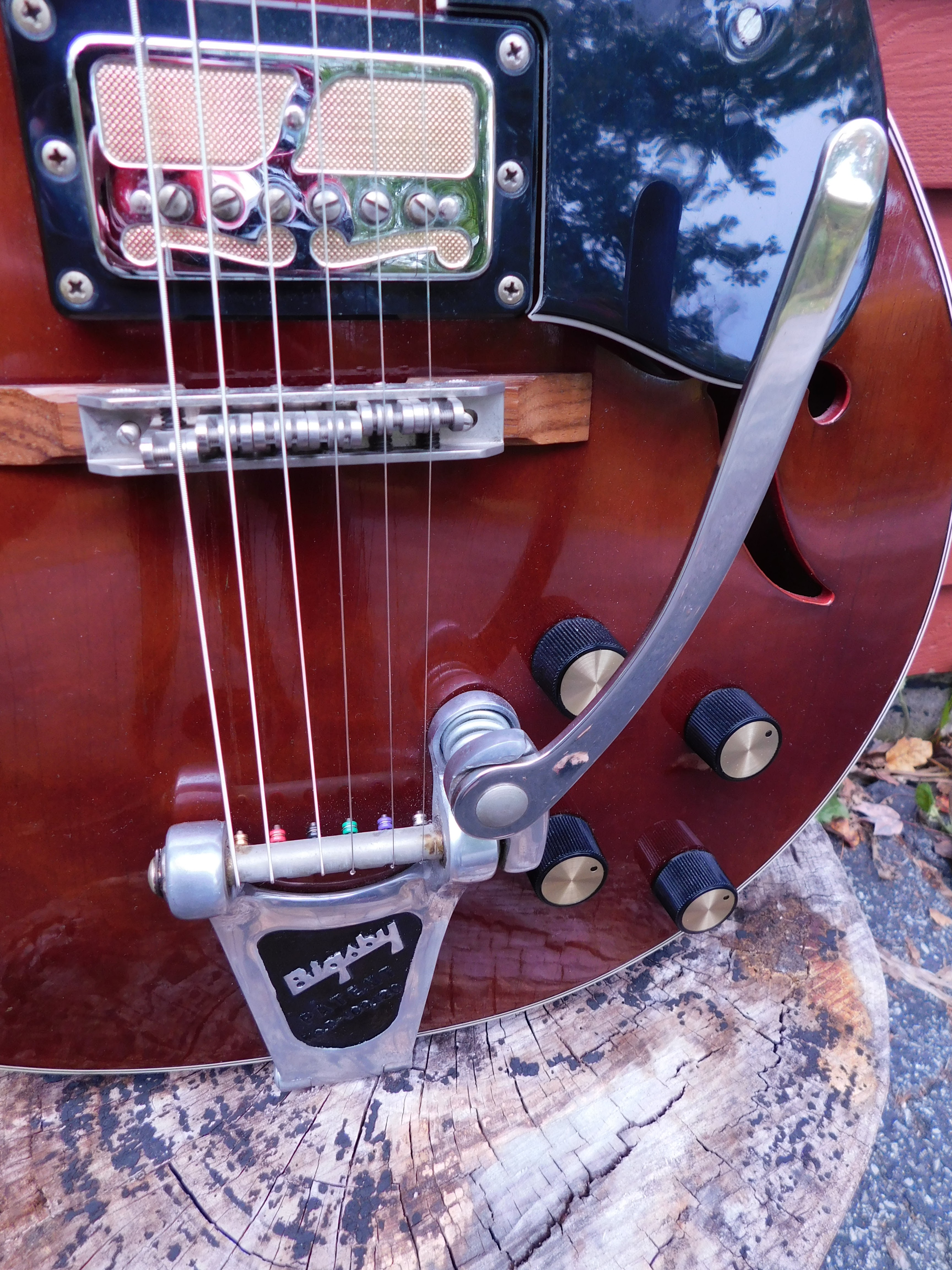
This is a Harmony H-72V.  It is the brother of the H-72.  The only difference is the H-72V has a Bigsby, which is pretty high cotton for a Harmony.  I am still in the process of dialing in the setup on this guitar, but it has already found its way into some recordings.  Those Dearmond pickups are where all the vibe exists in this guitar.  They are killer.  Crunchy or smooth, they are pretty versatile.  I have yet to experiment much with their smoothness, but was able to get some Stones like crunch on a recording, and therein lies the vibe.  

Some of the features on this guitar include an intonatable bridge which helps with the Bigsby.  The body and neck are very slim, and as stated earlier, the 3 position switch and those pickups make this a very underrated and versatile guitar.  What I wouldn't give for the neck to be nice and fat on this one, but it is about as slim as any electric neck I have ever played.  It is funny that many of the Harmony acoustics have big, fat necks and just about all of these semi hollows have really slim necks.  The Harmony Meteors also have real slim necks.  This is the trade off a guy like me has to make for that cool tone.  These were made between 1966-1971 and though there are a couple of them around, they are not that prevalent, especially with a Bigsby.


This guitar looks in pretty damn good shape, doesn't it?  That's what the seller led me to believe.  He took pictures from every angle except for the angle that showed how the guitar had been dropped at one time on the instrument jack.  He never mentioned it, and when I confronted him on it he said he didn't see it and that it happens to him all the time(being sold a bill of goods).  What a fucking douchbag!  Many of the guitars you see on this sight have been sold.  Never in a million years would I not describe an instrument as perfectly as I could.  I truly believe we are caretakers of these instruments, not shyster salesmen trying to make a buck at every turn.


You tell me if you wouldn't have noticed that!!  Oh well...I just don't know how some people sleep at night.

Fenderish headstock is a unique feature on these instruments


Saturday, June 5, 2021

Silvertone Classical Guitar - "Little Willie"


Who doesn't love Willie Nelson?  A great songwriter, singer, and guitarist.  His guitar playing in my opinion is completely underrated.  You can hear two notes and know immediately that it is Willie.  I think that is part of the definition of a good musician.  Not one who can copy every style out there, but rather one who has created his own.  No one else on earth would have put a pickup in a classical guitar, amplified it with a weird, Baldwin amp, and played gut strings with a flatpick.  Total Willie!!

Here is a Silvertone classical guitar that is meant to be a little bit of a tribute to The Red Headed Stranger.  I have never played a high end classical guitar, nor have I held Willie's Martin in my hands, so I can't make any quality comparisons.  What I can say is that for the price, if you can find one, these are a pretty good bargain.  They are out there and easy to find.  The problem(as it is with all these catalog guitars is finding one with a neck that isn't warped).  The neck on this one was dead straight.

Tough to nail down the exact maker.  The bridge and its bridge bolts are a Kay feature, but the serial number and made in the USA markings on the back of the headstock are Harmony features.  The work on this was done by James Ralston.  He reset the neck and bridge.  It plays great and is in tremendous shape for its age.  We put the ball end strings on it and added the beginnings of some indelible initials and carvings to replicate Willie's guitar.  It is thoroughly understood that the real mojo associated with "Trigger" is all the places it has been and all the songs it has played and created.  This guitar will never even come close to matching Willie's "Trigger" and all that it has seen, but it will be fun getting my friends and family to sign it.

I believe it is laminate construction, though there were some of these that were all hardwood.  This guitar would really benefit if it were re-braced.  The braces are the classic big and hunky Kay type that dampen the tone.  Not sure you want to put that kind of dough into it, but if money were not an issue, it could be worth it.


You can see how big and clunky those braces are.  Note the do not use steel strings warning.  More about that in the next post.


This guitar was never played.  The fretboard is this clean all the way up and down the neck.

some cool tiger stripes on the back of the neck.


even came with this cool cream colored chipboard case that is in as good a shape as the guitar.


Sunday, April 18, 2021

Airline Parlor Guitar


Here is a little Airline parlor guitar.  She is the sister of the Stella/Harmony H927.  Bought this guitar on the cheap, put a few bucks into it to set it up right, and I can hardly think of a time when I put my hard earned money to such good use.  The big challenge on these guitars is to find one with a straight neck.  Remarkably this one has a neck that is as straight as you will find.  It came to me in pretty good shape but I had to have a new compensated saddle made to lift the strings off the fretboard a bit.  When I got it the action was way too low for me and the strings were clanging all over the place.  It plays great now with D'Addario lights on it.  Such an incredibly fun fingerpicker with that ladder braced bark and volume.


Most, if not all of these guitars came with a floating bridge or a fixed bridge that was pinless.  A fixed bridge with pins does a world of good for these guitars.  You get a good string break angle and the tone will dynamically improve.  This bridge was installed by the last owner and is serviceable, the new saddle really made the difference.  The prior owner also put a Wenge(African hardwood) pickguard on it as well as a rosewood nut.


The real fun of these guitars comes when you place them side by side.  This Airline guitar is the same as the Stella H927.  Both were made by Harmony and simply distributed to different retailers.  The Airline was sold solely by Montgomery Wards, the Stella's were a little more ubiquitous.


Here they are side by side.  The Stella is on the left, Airline on the right.  They measure the same from head to toe.  The upper and lower bouts measure the same.  The body depth on the Stella is about1/16th of an inch deeper and when measured at the waist, the Stella's waist is 1/4" wider.  The mass of the Stella neck definitely exceeds that of the Airline and you can see the difference in these last two measurements in the photo.  The body and neck are visibly larger on the Stella.  That Stella isn't set up to play like the Airline, but I would love to hear Ry Cooder play slide on it!!!  It is loud and an old timey, blues machine.  Someday I will set it up like the Airline with a fixed bridge.  It will be a killer!
Fun, fun guitars.  Just make sure you ask the right questions before purchasing and pay the right price.

Wednesday, September 2, 2020

Funky German Archtop


Don't know a whole lot about this one.  I do believe it is a German made guitar much like a Hoyer.  It is a pretty fun ride when you get it plugged in.  Acoustically it sounds like your run of the mill archtop, but when you plug it in and crank it up that little soap bar pickup gets real nasty.  It is all original save for the updated Kluson tuners.  Check out those wild pearloid fret markers.


Not crazy about the offset style headstock, but the rest of the guitar more than makes up for it.


Sunday, August 30, 2020

1969 Barclay Acoustic Guitar


Here we have a 1969 Barclay guitar.  These were made by Harmony and are basically the h-1203 model rebranded with the Barclay headstock.  As I have noted many times before Harmony would make guitars for different catalogs, each catalog giving the instruments their own brand name.  In this case it is believed that these Barclays were made for W.T Grants department store, more widely known simply as Grants.  You don't see many of these Barclay branded instruments around, certainly not in this good of shape.

This guitar is all original and besides a neck reset at some point is completely untouched.  It looks almost unplayed.  I had to ask if it was refinished because the finish looked so good on it.  It wasn't refinished, just super clean.  This guitar has the Sovereign H-1203 specs.  15" lower bout, 11.5" upper bout, and a nice, thick neck with a 1.75" wide nut.  It is ladder braced and very loud with a less refined tone due to the ladder bracing as well as the fact that it has barely been played.  This guitar is already incredible, I can only imagine what it would sound like with X-bracing as well as a pin bridge.  Particularly attractive was the sunburst finish on it.  Most(is not all) Sovereigns had a natural finish, making this even more of a rarity.

Is this thing clean or what?


Made in the good ol' USA.  You don't get to see that much anymore.  Grants closed down in 1976.  You will find some electrics out there with the Barclay name on it that were made in Japan.  You can be sure that all these earlier model acoustics were harmony made in Chicago.


I have never been a big fan of the string through bridge.  I imagine this was a cost and time saving production choice.  I have converted a few of these to pin bridges and you can hear a pretty big difference in tone quality.


A little tough to see, but if you squint you will notice a date stamp as well as another made in the USA stamp below the date.  Unlike Kay, Harmony made it easy to date their instruments.  The numbers indicate the year and the letter(which would be an S or an F) indicates either a summer or fall production.  Here we see S-69, which tells us this guitar came off the line in the summer of '69.  Wasn't that the year that Bryan Adams "got his first real 6 string at the five and dime?"


Thursday, August 27, 2020

David Lindley


When it comes to catalog guitars few people were farther ahead of the curve in terms of their cool factor than David Lindley.  It seems David has been playing these things most of his career.  I could only imagine what his collection looks like and what a hoot it would be to sort through it and all it's oddities.  David was the one who provided Ry Cooder with the gold foil pickup that balances out his Coodercaster.

This is Lindley's 2nd record with his band El Rayo-X.  The front and back of the album cover are full of funky old guitars.  Lindley was just looking for different sounds so he would scour the pawn shops trying to find something that didn't just sound like another Strat or Les Paul.  On the front cover he is pictured with a late 50's Barney Kessel Kay Guitar with the Kelvinator headstock.  His bass player and guitar player(Jorge Calderon and Bernie Larsen) are holding Airline Map bass and electric guitars with National branding on the headstock.


Here's a partial list of the guitars of the guitars that can be seen on the album... which by the way is a fun listen!!

Kay Barney Kessel

Airline Map bass and electric guitar

Danelectro Longhorn guitar

Teisco 6 string baritone/bass guitar

Danelectro Doubleneck

Silvertone 1457 or 1448 guitar( can only see the back of it so you can't tell if it is the single or double pickup model)

Its really impressive to think that this album came out in 1982.  No one was playing these guitars back then.